Activewear Yarn Guide: What to Spec Before Knitting Starts
Fabric conversations usually start too late — at the swatch. Hand-feel, durability and dye behaviour are largely decided one step earlier, in the yarn. This is the guide to that step.
Quick answer: Four yarn decisions shape an activewear fabric: polymer (nylon 6 vs 6,6 vs polyester), elastane brand (Lycra®/Creora® vs generic — consistency and special variants), denier (yarn thickness; lower = finer, softer, sheerer) and filament count (more filaments at the same denier = the “buttery” microfibre hand). A typical premium legging yarn reads like 40D/68F nylon 6,6 + 30D Lycra®.
Nylon 6 vs nylon 6,6
Both are polyamides; 6,6 has a tighter molecular structure that gives a softer, drier hand, better abrasion resistance and higher heat tolerance — at a higher price. Nylon 6 dyes slightly deeper and is the workhorse of mid-market seamless. Premium “naked-feel” fabrics are usually microfibre nylon 6,6. Polyester belongs in this conversation for print-heavy programs (sublimation) and lower cost — the full comparison is in nylon vs polyester.
Branded vs generic elastane
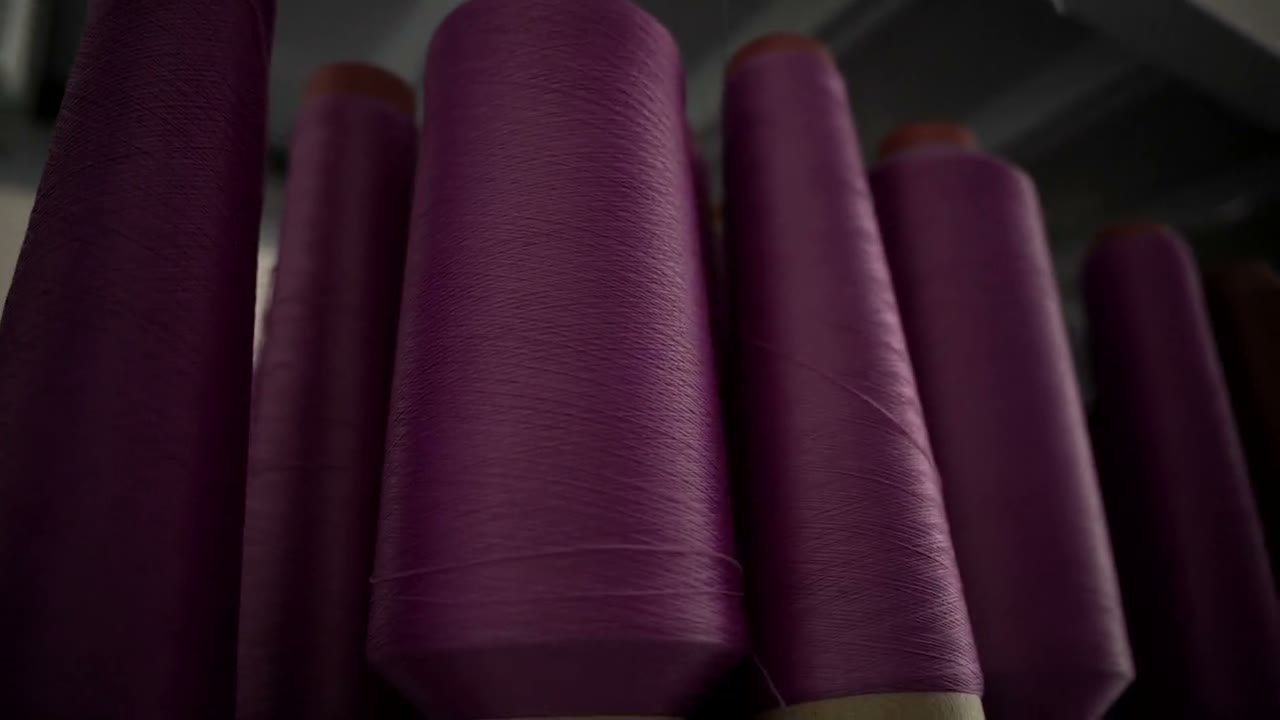
All elastane is chemically similar; what brands like Lycra® and Creora® sell is consistency and variants: tighter batch tolerance (recovery behaves the same in January and June), chlorine-resistant grades for swim, heat-settable grades for sharper shaping. On a long-running premium program the consistency pays for itself; on stock-fabric programs a vetted generic performs well. What matters either way is the recovery spec on the fabric report, not the logo on the cone.
Denier and filament count — the “buttery” variables
| Spec | What it is | Effect |
|---|---|---|
| Denier (D) | Yarn thickness | Lower D = finer, lighter, softer — and sheerer |
| Filament count (F) | Strands twisted into the yarn | More F at same D = softer, smoother, matte |
| Example: 40D/68F | Fine microfibre nylon | The naked-feel class of fabric |
| Example: 70D/24F | Thicker, fewer filaments | Durable, more opaque, sportier hand |
The famous buttery hand is mostly high filament count microfibre — dozens of ultra-fine strands presenting a smooth, matte surface (the formula we break down in the buttery fabric guide). The trade-off is opacity and snag resistance, which is why density (GSM) has to rise as denier falls.
Speciality yarns worth knowing
GRS recycled nylon/polyester for certified sustainable programs; cooling yarns (flat-cross-section “ice” nylons) for summer sets; cationic-dyeable polyester for two-tone melange effects. Each is a sourcing decision with lead-time and minimum implications — worth one conversation before the line plan is fixed.
How to read (and write) a yarn spec
A complete fabric card states polymer and grade, yarn spec for each component (e.g. 40D/68F nylon 6,6 + 30D elastane), composition percentages, GSM, and performance results (stretch, recovery, pilling, colourfastness). If a supplier cannot produce that card, you are buying a swatch, not a specification. Our tech pack guide shows where each line lives.
How Yesseam sources yarn
We knit from a standing yarn library (nylon 6 and 6,6, branded and vetted elastane, GRS options) so development starts from proven cones — and every program’s fabric card names its yarns explicitly, so your season two matches your season one.
To turn these yarn decisions into a full fabric clause, try the free Seamless Fabric Spec Builder.
FAQ
Does branded elastane really matter?
For long-running premium programs, yes — the value is batch-to-batch consistency and special grades (chlorine-resistant, heat-settable), not a different polymer. For stock programs, a quality generic with a good recovery report performs equivalently.
What yarn makes fabric feel buttery?
High filament-count microfibre nylon — many ultra-fine strands at low denier (e.g. 40D/68F), usually nylon 6,6, knitted dense. The filaments, not a chemical finish, create the smooth matte hand.
Which yarn should print-heavy brands choose?
Polyester — sublimation printing bonds to polyester, not nylon. For solid-colour premium hand-feel, nylon wins; the print-vs-hand trade is the core of the nylon-vs-polyester decision.
Is recycled yarn lower quality?
Certified recycled nylon and polyester (GRS) now match virgin performance in normal activewear use; the practical differences are price, shade consistency between lots, and supply lead times — manageable with planning.
Developing this product?
Yesseam is a vertically integrated seamless activewear factory in Xiamen — in-house knitting, dyeing partners, sewing and QC, with stock programs from 50 pcs plain or 100 pcs with your logo, and custom development from 500 pcs. Send your idea or tech pack and we will come back with options and honest numbers within 24 hours.
Get a quote