Sports Bra Sizing: Alpha vs Cup, and When Each Wins
Bra sizing is where activewear brands inherit a century of lingerie complexity — or skip it. The choice between S/M/L and 34B changes your SKU count, your returns rate and who you can honestly serve.
Quick answer: Alpha sizing (XS–XL) is right for light-to-medium support seamless bras: stretch tolerance absorbs the fit range, SKUs stay manageable, and shoppers self-select easily. Band/cup sizing (32A–38DD+) earns its complexity only at high-impact support, where band tension and cup volume must be engineered separately. The hybrid that works: alpha sizes defined by a band-and-bust range table — plus honest guidance for customers between sizes.
Why activewear went alpha
A seamless bra with 20–25% elastane tolerates several centimetres of band variation per size — so six alpha sizes can genuinely cover what lingerie needs twenty-plus band/cup SKUs to serve. Fewer SKUs mean deeper stock per size, simpler restocks and a chart shoppers read in five seconds. For light-to-medium support (see bralette engineering), alpha is not a compromise — it is correct.
When band/cup earns its keep
High-impact support is a mechanical problem: most support comes from the band, and band tension must be right for the ribcage while cup volume is right for the bust — two independent variables. One alpha size cannot hold both for a 32DD and a 36B, though both may “be” a Medium. If your line promises running-grade support, band/cup (or at least split sizing like M-C/D) is the honest architecture.
The range-table hybrid
| Alpha size | Underband fits | Bust range |
|---|---|---|
| S | 63–73 cm | 81–89 cm |
| M | 68–78 cm | 86–94 cm |
| L | 73–83 cm | 91–99 cm |
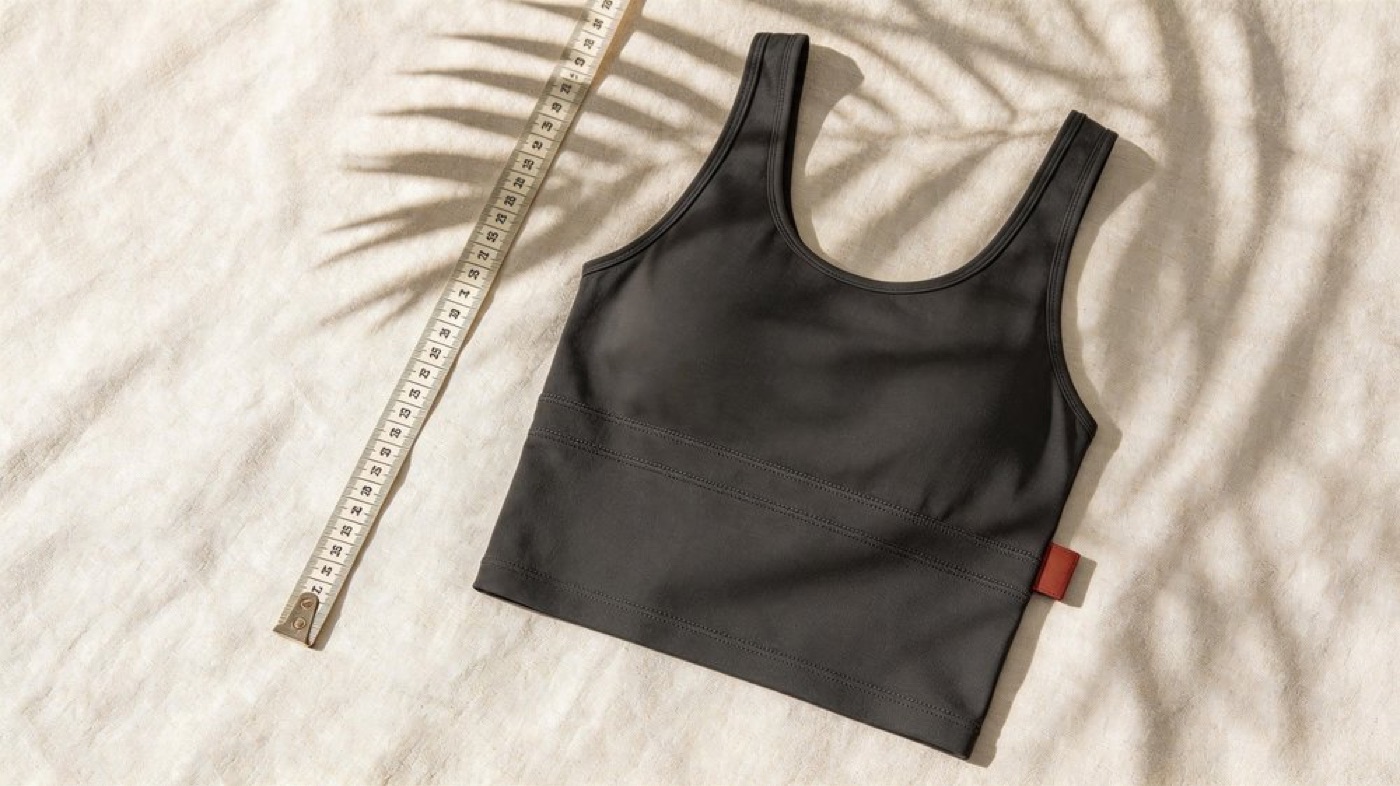
Publishing alpha sizes as ranges (band + bust, in cm) converts the vague S/M/L into something a customer can measure against — and it is the single cheapest returns-reduction move in the category. Add one honest sentence for between-sizes: “between sizes? size down for support, up for comfort.”
Sister-size logic, borrowed
Lingerie’s sister-size rule (34B ≈ 32C ≈ 36A in volume) explains why alpha works as well as it does — many band/cup combinations collapse into the same garment volume, which is exactly what an alpha size is. Knowing this also helps your support copy: a customer used to 34B knows her M; a 32E does not have an honest alpha home in a light-support style, and your chart should say so rather than sell to her anyway.
Speccing it at the factory
Whatever the labelling, the factory needs numbers: underband relaxed + extended, bust, underband recovery spec (the growth logic from our QC thresholds), and pad pocket dimensions per size. Grading follows the standard rules — bands grade ~5 cm per size, and the fit round happens on bodies at the size edges, not just the sample size.
How Yesseam sizes bras
Alpha with published range tables on stock programs; split or band/cup architecture on custom high-support developments — and we will tell you plainly when a design brief’s support promise has outgrown alpha sizing.
FAQ
Should my first sports bra use S/M/L or band/cup sizes?
For seamless light-to-medium support: alpha (S/M/L) with a published band-and-bust range table. Band/cup only becomes necessary when you promise high-impact support, where band and cup must be engineered independently.
How many alpha sizes cover a launch?
Four (XS–L) covers the core honestly; add XL/XXL as data justifies. The bigger lever is publishing cm ranges per size — it does more for returns than adding a fifth size does.
What is a sister size?
Band/cup combinations with the same cup volume — 34B ≈ 32C ≈ 36A. It is why alpha sizing works: those sisters are one garment volume, i.e. one alpha size.
What should the factory receive regardless of labels?
Centimetres: underband relaxed/extended, bust, band recovery spec, pad pocket dims, per size. Labels are marketing; the pattern room builds from numbers.
How should a sports bra fit?
The band should sit level and snug — firm enough that it does not ride up when you raise your arms, since most support comes from the band. Straps should rest without digging in, and the cups should hold the bust without spilling over the top or gaping. If the band rides up, it is too loose, whatever the letter on the label says.
How do I find my sports bra size?
Measure your underband and the fullest part of your bust in centimetres, then compare both numbers with the brand's range table rather than going by the letter alone. If you fall between two sizes, size down for more support or up for more comfort. For high-impact training, a band-and-cup sized bra will usually fit more precisely than an alpha size.
Why is a sports bra important for training?
Because it limits breast movement during impact, which is what most wearers notice as discomfort during running, jumping and high-intensity work. The support comes mainly from a firm band; the right level depends on the activity, from light support for yoga to high support for running.
How do I wash a seamless bra and keep it in shape?
Wash it cool and dry it flat or on a line — high heat weakens elastane, which is what gives a seamless bra its hold. If the removable pads fold or shift after washing, take them out and lay them flat back in their pockets while the bra is dry; they settle back into shape with wear.
Developing this product?
Yesseam is a vertically integrated seamless activewear factory in Xiamen — in-house circular knitting, dyeing partners, sewing and QC, with stock programs from 50 pcs plain or 100 pcs with your logo, and custom development from 500 pcs. Send your idea or tech pack and get options and honest numbers within 24 hours.
Get a quote